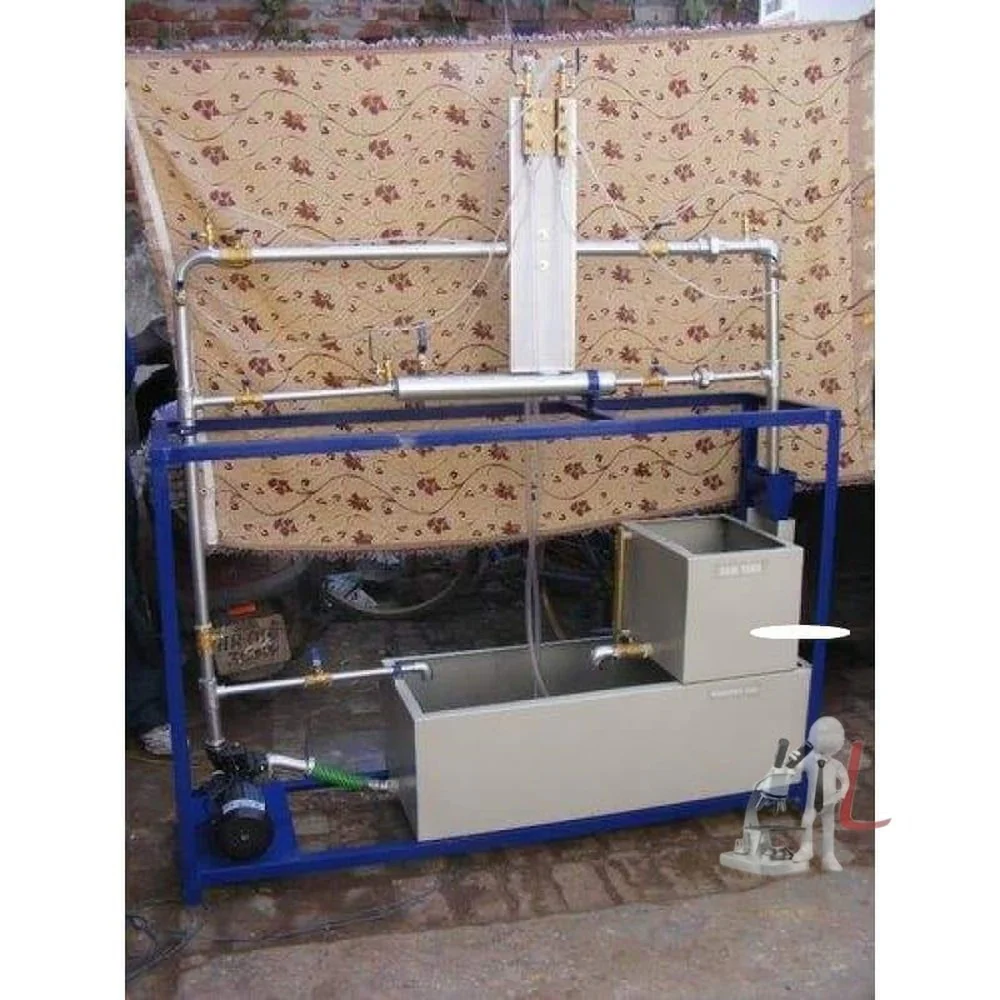
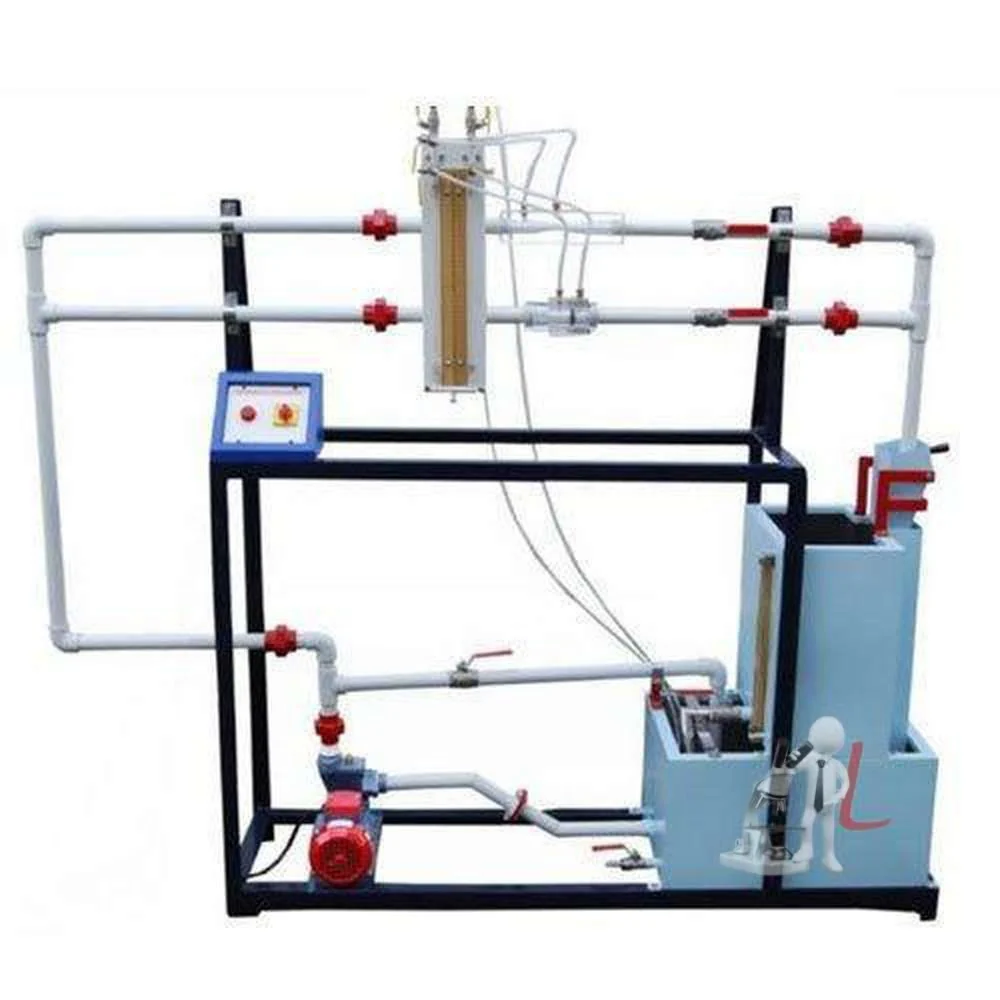
Boundary ram test rig
Boundary ram test rig
Boundary ram test rig The test section of “Boundary Layer Apparatus” has been developed to perform various experiments of aerodynamics and fluid flow. This is a open circuit Wind Tunnel, provides a region of air flow. A layer of fluid, which comes in contact with the boundary surface, adheres to it on account of viscosity, as a real fluid flow past a solid boundary. As a result, ‘no slip’ condition prevails. If the boundary is at rest, the fluid at the boundary has zero velocity and the velocity increases if the fluid is away from the boundary. Thus, there, is a thin layer in the vicinity of the boundary within which the velocity has been affected because of the boundary & viscous effects. This thin layer has been termed as the “Boundary Layer”.
Learning Objectives/Experiments:
To study the boundary layer velocity profile.
To determine boundary layer thickness & displacement thickness.
To determine the exponent in the power-law of velocity distribution.
Required for Operation:
Electricity supply: Single phase, 220V AC, 50 Hz, 5-15 amp combined socket with earth connection. Earth voltage should be less than 5 volts.
Floor Area: 4 m x 1.5 m.
Technical Specifications:
Type : Open Type Wind Tunnel.
Test Section : 200 mm x 200 mm.
Blower : Compatible Capacity
Motor : Compatible Capacity
U Tube Manometer : Length 1 m.
Pitot Tube : Micro pitot tube with scale arrangement
The whole set-up is ingeniously designed and schematically arranged on a powder-coated rigid structure
Control Panel:
Standard make On/Off switch, Mains Indicator etc.
RPM measurement : RPM Indicator with Proximity sensor.
Scope of Delivery:
Self Contained “BOUNDARY LAYER APPARATUS.”Apparatus
Instruction Manual consisting of experimental procedures, block diagram etc.
Original: $2,169.13
-70%$2,169.13
$650.74Product Information
Product Information
Shipping & Returns
Shipping & Returns
Description
Boundary ram test rig
Boundary ram test rig The test section of “Boundary Layer Apparatus” has been developed to perform various experiments of aerodynamics and fluid flow. This is a open circuit Wind Tunnel, provides a region of air flow. A layer of fluid, which comes in contact with the boundary surface, adheres to it on account of viscosity, as a real fluid flow past a solid boundary. As a result, ‘no slip’ condition prevails. If the boundary is at rest, the fluid at the boundary has zero velocity and the velocity increases if the fluid is away from the boundary. Thus, there, is a thin layer in the vicinity of the boundary within which the velocity has been affected because of the boundary & viscous effects. This thin layer has been termed as the “Boundary Layer”.
Learning Objectives/Experiments:
To study the boundary layer velocity profile.
To determine boundary layer thickness & displacement thickness.
To determine the exponent in the power-law of velocity distribution.
Required for Operation:
Electricity supply: Single phase, 220V AC, 50 Hz, 5-15 amp combined socket with earth connection. Earth voltage should be less than 5 volts.
Floor Area: 4 m x 1.5 m.
Technical Specifications:
Type : Open Type Wind Tunnel.
Test Section : 200 mm x 200 mm.
Blower : Compatible Capacity
Motor : Compatible Capacity
U Tube Manometer : Length 1 m.
Pitot Tube : Micro pitot tube with scale arrangement
The whole set-up is ingeniously designed and schematically arranged on a powder-coated rigid structure
Control Panel:
Standard make On/Off switch, Mains Indicator etc.
RPM measurement : RPM Indicator with Proximity sensor.
Scope of Delivery:
Self Contained “BOUNDARY LAYER APPARATUS.”Apparatus
Instruction Manual consisting of experimental procedures, block diagram etc.