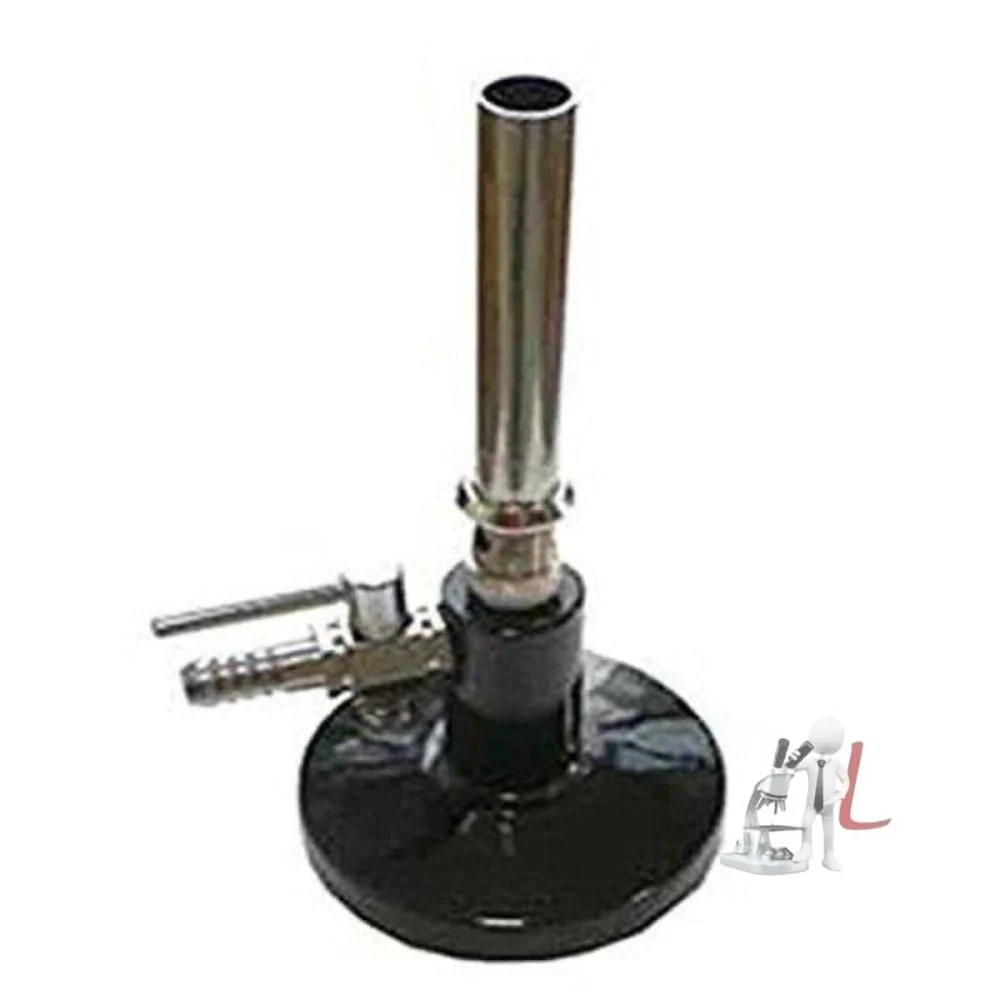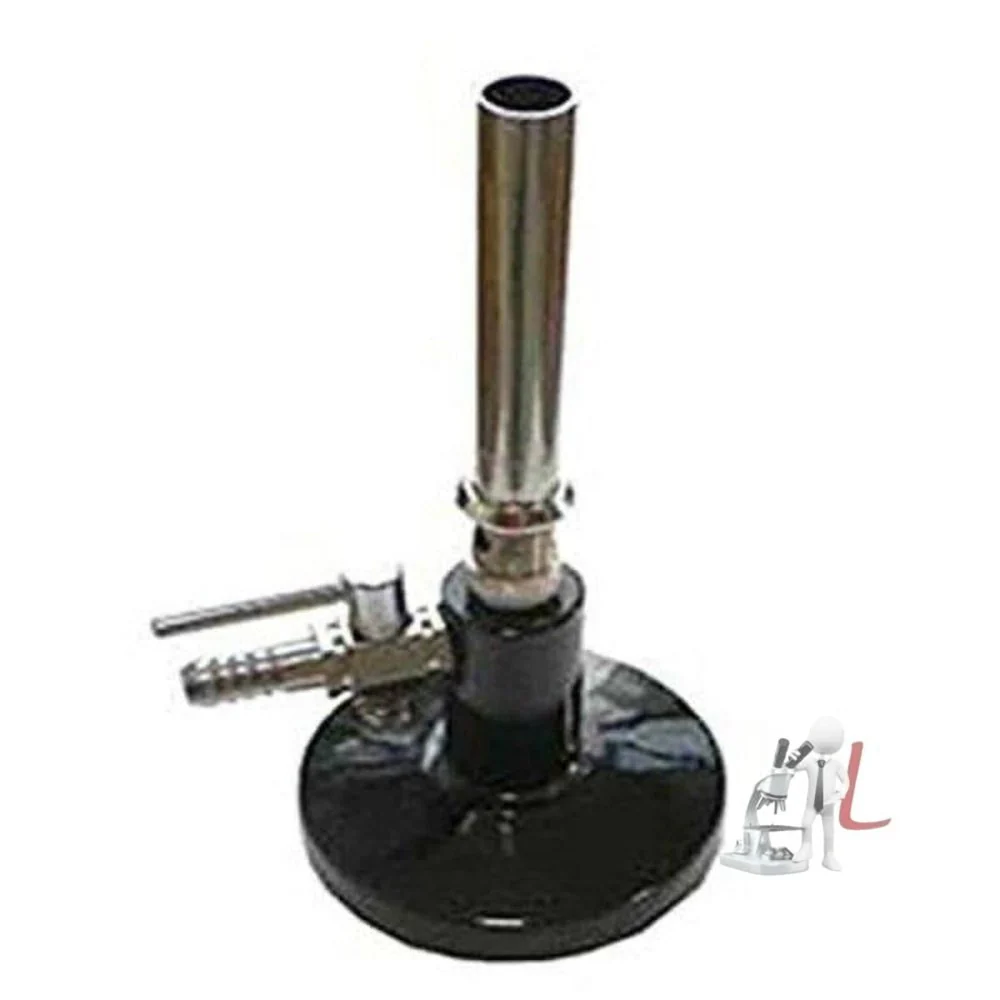
Iron Bunsen Burner for lab
Bunsen burner, device for combining a flammable gas with controlled amounts of air before ignition; it produces a hotter flame than would be possible using the ambient air and gas alone. Named for Robert Bunsen, the German chemist who introduced it in 1855 (from a design by Peter Desdega, who likely modified an earlier design by Michael Faraday), the Bunsen burner was the forerunner of the gas-stove burner and the gas furnace. The Bunsen burner consists of a metal tube on a base with a gas inlet at the lower end of the tube, which may have an adjusting valve; openings in the sides of the tube can be regulated by a collar to admit as much air as desired. The mixture of air and gas (optimally about 1 part gas to 3 parts air) is forced by gas pressure to the top of the tube, where it is ignited with a match. It burns with a pale blue flame, the primary flame, seen as a small inner cone, and a secondary, almost colourless flame, seen as a larger, outer cone, which results when the remaining gas is completely oxidized by the surrounding air.
-

Bunsen burner.Encyclopædia Britannica, Inc.
The hottest part of the Bunsen flame, which is found just above the tip of the primary flame, reaches about 1,500 °C (2,700 °F). With too little air, the gas mixture will not burn completely and will form tiny carbon particles that are heated to glowing, making the flame luminous. With too much air, the flame may burn inside the burner tube; that is, it may strike back. The Meker and Fisher burners, variations of the original Bunsen burner, have metallic grids to increase the turbulence of the mixture and keep the flame at the top of the tube. The Fisher burner uses forced air. There is no secondary flame dependent on surrounding air, because these improvements introduce sufficient air for complete combustion, and the heat of the primary flame is augmented.

|
We only ship to your confirmed address. Please make sure your shipping address is co |

Original: $2.13
-70%$2.13
$0.64Product Information
Product Information
Shipping & Returns
Shipping & Returns
Description
Bunsen burner, device for combining a flammable gas with controlled amounts of air before ignition; it produces a hotter flame than would be possible using the ambient air and gas alone. Named for Robert Bunsen, the German chemist who introduced it in 1855 (from a design by Peter Desdega, who likely modified an earlier design by Michael Faraday), the Bunsen burner was the forerunner of the gas-stove burner and the gas furnace. The Bunsen burner consists of a metal tube on a base with a gas inlet at the lower end of the tube, which may have an adjusting valve; openings in the sides of the tube can be regulated by a collar to admit as much air as desired. The mixture of air and gas (optimally about 1 part gas to 3 parts air) is forced by gas pressure to the top of the tube, where it is ignited with a match. It burns with a pale blue flame, the primary flame, seen as a small inner cone, and a secondary, almost colourless flame, seen as a larger, outer cone, which results when the remaining gas is completely oxidized by the surrounding air.
-
Bunsen burner.Encyclopædia Britannica, Inc.
The hottest part of the Bunsen flame, which is found just above the tip of the primary flame, reaches about 1,500 °C (2,700 °F). With too little air, the gas mixture will not burn completely and will form tiny carbon particles that are heated to glowing, making the flame luminous. With too much air, the flame may burn inside the burner tube; that is, it may strike back. The Meker and Fisher burners, variations of the original Bunsen burner, have metallic grids to increase the turbulence of the mixture and keep the flame at the top of the tube. The Fisher burner uses forced air. There is no secondary flame dependent on surrounding air, because these improvements introduce sufficient air for complete combustion, and the heat of the primary flame is augmented.
|
We only ship to your confirmed address. Please make sure your shipping address is co |